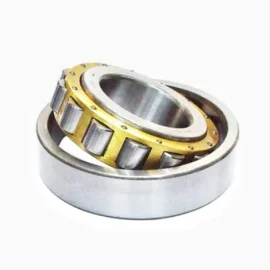


The N317 ECM is a specific type of cylindrical roller bearing. Here’s a breakdown of its key features and specifications:
1. Bearing Type: Cylindrical Roller Bearing
- Cylindrical roller bearings are designed to handle high radial loads and moderate axial loads. They have high rigidity and are suitable for high-speed applications.
2. Bearing Designation: N317 ECM
- N: Indicates the bearing type. In this case, “N” refers to a cylindrical roller bearing with no flanges on the outer ring, allowing the inner ring and rollers to be displaced axially.
- 317: Represents the size and dimensions of the bearing. The “3” indicates a medium series, and “17” refers to the bore diameter (17 x 5 = 85 มิลลิเมตร).
- ECM: Stands for Enhanced Capacity Model. This indicates that the bearing has an optimized internal design, such as improved roller profiles and surface finishes, to increase load-carrying capacity and reduce stress.
3. มิติ:
- Bore Diameter (d): 85 มิลลิเมตร
- Outer Diameter (D): 180 มิลลิเมตร
- ความกว้าง (B): 41 มิลลิเมตร
4. Load Ratings:
- Dynamic Load Rating (C): The maximum load the bearing can handle while rotating. For N317 ECM, this is typically around 220 เคโน (exact value depends on the manufacturer).
- Static Load Rating (C0): The maximum load the bearing can handle while stationary. For N317 ECM, this is typically around 240 เคโน.
5. Speed Ratings:
- จํากัดความเร็ว: The maximum rotational speed the bearing can handle. For N317 ECM, this is typically around 4000 rpm for grease lubrication and 5000 rpm for oil lubrication.
6. Applications:
- Cylindrical roller bearings like the N317 ECM are commonly used in:
- Industrial gearboxes
- Electric motors
- Pumps
- Compressors
- Machine tools
- Wind turbines
7. Advantages of ECM Design:
- Higher load-carrying capacity
- Reduced stress on rollers and raceways
- Improved fatigue life
- Better performance under heavy loads and high speeds
8. Manufacturer-Specific Variations:
- Different manufacturers (e.g., เอสเคฟ, เอ็นเอสเค, Timken) may have slight variations in dimensions, load ratings, and tolerances. Always refer to the manufacturer’s datasheet for precise details.
If you need further details or specific data, let me know!